


The hack squat is a powerful exercise for building lower body strength and muscle mass in the legs. It allows you to push high intensities while limiting direct spinal loading, making it an excellent alternative to traditional squats.
By performing hack squats, you can target and develop your gluteal muscles while engaging multiple lower body muscle groups. This comprehensive guide will walk you through everything you need to know about using the hack squat to maximize glute development, including proper form, optimal foot positioning, and programming strategies.
Key Takeaways
- Effective exercise for targeting and developing gluteal muscles
- Proper form and foot positioning are crucial for maximizing glute development
- Programming strategies to incorporate hack squats into your routine
- Avoid common mistakes that limit your results
- Improve overall lower body strength with hack squats
Understanding the Hack Squat
Understanding the hack squat is crucial for anyone looking to enhance their glute development. The hack squat is performed on a dedicated machine characterized by its 45-degree angle, providing support for your back and shoulders.
What Is a Hack Squat?
The hack squat is a compound lower body exercise that guides your movement along a fixed path, offering stability and allowing you to focus on muscle activation. It’s named after George Hackenschmidt, who popularized a similar movement pattern.
Hack Squat vs. Traditional Squat
The primary difference between the hack squat and the traditional barbell back squat lies in stability. The hack squat machine supports your back and body, whereas a traditional squat requires you to stabilize yourself. This makes the hack squat an excellent option for those with back concerns or those looking to target their glutes and quads.
Benefits of Hack Squats for Lower Body Development
The hack squat is a highly effective exercise for lower body development, offering several key benefits. By incorporating hack squats into your workout routine, you can target your legs without putting excessive strain on your spine.
Reduced Spinal Loading
One of the primary advantages of the hack squat is its ability to reduce spinal loading. The machine’s design supports your back throughout the movement, allowing you to train with heavier weights without placing excessive stress on your spine. This is particularly beneficial for individuals who need to mitigate overall fatigue, especially neural fatigue.
Enhanced Muscle Isolation
The hack squat machine provides a fixed movement pattern and stability, enabling you to focus more intensely on the target muscles. This enhanced muscle isolation allows for more effective training of the quadriceps, glutes, and adductors.
Improved Range of Motion
Hack squats enable you to achieve a deeper squat compared to free weights, leading to greater muscle activation and growth potential. By manipulating foot position and depth, you can maximize gluteal engagement while maintaining proper form throughout the movement.
Overall, the hack squat is a valuable exercise for lower body development, providing a safe and effective way to target key muscle groups. Its benefits make it an essential addition to any leg workout routine.
Muscles Worked During Hack Squats
The hack squat is a compound exercise that targets multiple muscle groups in the lower body, making it an effective exercise for building strength and size.
Primary Muscles: Quadriceps and Glutes
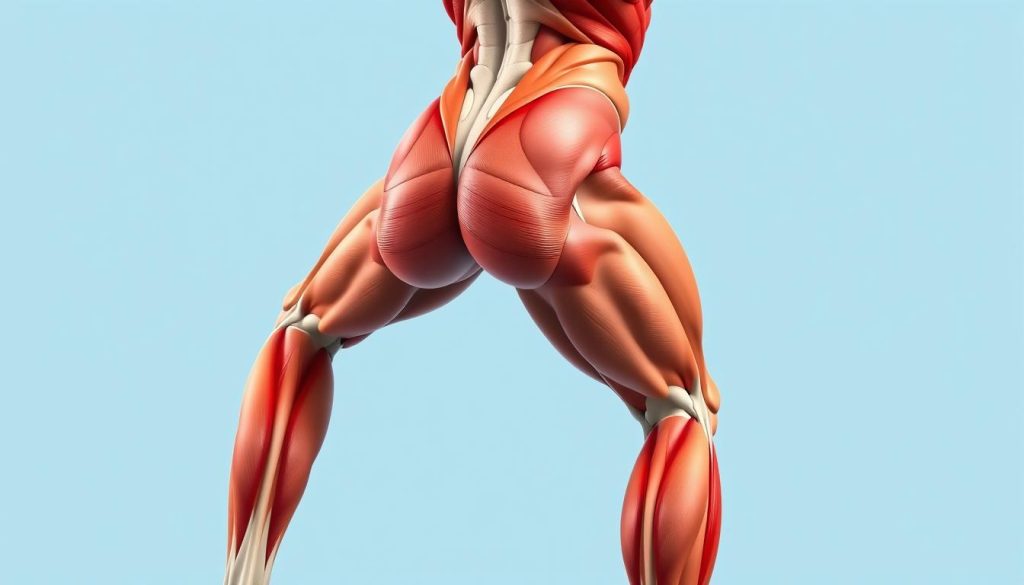
The hack squat primarily engages the quadriceps and glutes. Your quadriceps, comprising four muscles at the front of your thigh, bear a significant amount of work, especially with a lower foot position on the platform. The gluteal muscles, particularly the gluteus maximus, are heavily activated, especially when using a higher foot placement and focusing on full depth.
Secondary Muscles: Hamstrings, Adductors, and Calves
In addition to the primary muscles, hack squats also engage several secondary muscle groups. The hamstrings assist in hip extension during the upward phase, though they’re not stretched as much as in other exercises. The adductors (inner thigh muscles) and calves (gastrocnemius) play important stabilizing roles, with their activation levels depending on foot placement and technique.
By understanding the muscles worked during hack squats, you can better tailor your training to target specific areas, enhancing overall lower body development.
Hack Squat Workout For Glutes: Proper Form and Technique
Effective glute training with hack squats hinges on correct machine setup and execution. To get the most out of this exercise, it’s crucial to understand the proper form and technique.
Setting Up the Machine Correctly
To start your hack squat workout, you need to set up the machine correctly. Position your back firmly against the backrest, with your shoulders securely under the pads. Ensure your body is properly aligned before unlocking the safety mechanism. For optimal glute engagement, place your feet higher on the platform, about shoulder-width apart, with your toes slightly pointed outward.
Proper foot positioning is key to targeting the glutes effectively. By placing your feet higher on the platform, you shift the emphasis from the quadriceps to the glutes.
Step-by-Step Execution
The step-by-step execution of the hack squat involves several key steps. First, unlock the machine and stand up, letting the weight settle for a second or two. Based on the weight you’re using, brace accordingly and start to descend with a smooth and controlled tempo. Once you’ve hit your end range of motion, drive your feet into the platform, keeping an even pressure throughout your foot. Continue to keep your hips and torso anchored throughout the movement.
As you lower yourself with control, ensure your knees reach at least a 90-degree angle before driving through your heels to return to the starting position.
Breathing and Bracing Techniques
Proper breathing and bracing techniques are essential for maximizing glute activation. Inhale deeply into your diaphragm during the descent, brace your core throughout the movement, and exhale forcefully as you drive upward. Maintain tension in your glutes throughout the entire range of motion to get the most out of the exercise.
By mastering the breathing and bracing techniques, you can enhance your overall performance and effectively target your glutes.
Foot Positioning for Maximum Glute Activation
Foot positioning plays a vital role in targeting the glutes effectively during hack squat workouts. The way you place your feet on the platform can significantly influence the muscle groups being engaged.

High Foot Position for Glute Focus
Placing your feet higher on the platform during a hack squat decreases knee flexion and increases hip flexion. This adjustment shifts the workload from the quadriceps to the glutes, making it an effective way to target the glute muscles. To bias the glutes, keep your feet around hip-width apart and bring them up on the platform. The goal is to achieve as much stretch as possible on the glute max as you reach your end range of motion.
Wide Stance for Glute and Adductor Engagement
Adopting a wide stance with your feet beyond shoulder-width apart on the hack squat machine engages both the glutes and adductors more intensely. This stance allows for a deeper squat and results in a greater stretch in the glute muscles. Going wide with your stance sets the stage to focus more on your adductors and glutes, making it a valuable variation for those looking to target these areas.
Externally Rotated Foot Position
Externally rotating your feet by turning your toes outward at approximately 30-45 degrees can further enhance glute activation. This foot position improves hip mobility and creates a more favorable angle for gluteal engagement. By rotating your foot so that your toes face more outward, you’re setting up to improve hip mobility and increase the effectiveness of the hack squat for glute development.
Experimenting with combinations of these foot positions, such as a high and wide stance with external rotation, can help you find the optimal setup for your individual anatomy and glute-building goals. By adjusting your foot positioning, you can maximize glute activation and achieve a more effective workout.
Common Mistakes to Avoid When Targeting Glutes
To maximize glute activation during hack squats, several pitfalls must be avoided. The effectiveness of this exercise for glute development largely depends on proper form and technique.
Improper Foot Placement
One of the most common errors is improper foot placement. Positioning your feet too high on the platform can cause your lower back to flex or round, pulling it away from the back pad. This misalignment can shift some of the squat’s load to your lower back, potentially raising injury risks. It’s essential to find the optimal foot position where your feet are as high as possible while keeping your back firmly against the pad.
Insufficient Range of Motion
Another critical mistake is insufficient range of motion. Not descending deep enough during the squat limits glute activation since the gluteal muscles are most engaged in the deeper portions of the movement. Ensuring a full range of motion is crucial for effective glute development.
Losing Back Contact with the Pad
Losing back contact with the pad during the movement is particularly problematic. It can place unwanted stress on the lower back and reduce the stability benefits provided by the hack squat machine. Maintaining consistent contact between your back and the pad is vital for both safety and effectiveness.
Other mistakes to avoid include using too much weight too soon, bouncing at the bottom of the movement, and failing to maintain tension in the glutes throughout the entire range of motion. By being mindful of these potential pitfalls, you can optimize your hack squat workout for glute development.
Programming Hack Squats for Glute Development
To effectively program hack squats for glute development, several key training variables must be considered. A well-structured training plan can help optimize results and ensure continued progress.
Sets, Reps, and Weight Recommendations
For hypertrophy, a balanced approach works best: 3-4 sets of 8-12 reps with moderate to heavy weight. For strength development, 4-5 sets of 4-6 reps with heavier weight are recommended. This allows for a balance between muscle growth and strength gains.
Tempo and Time Under Tension
Tempo manipulation is a powerful tool for glute development. Using a controlled eccentric phase (3-4 seconds down), a brief pause at the bottom, and an explosive concentric phase can maximize time under tension and glute activation. As noted by a strength training expert, “keeping a smooth tempo throughout the concentric phase can help you get more ‘feel’ with this exercise.”
Frequency and Recovery Considerations
Frequency considerations should balance sufficient stimulus with adequate recovery. Most lifters benefit from including hack squats 1-2 times per week, allowing 48-72 hours between sessions targeting the same muscle groups. Progressive overload remains essential for continued development, so gradually increasing weight, reps, sets, or decreasing rest periods over time will ensure ongoing glute growth and strength improvements.
By carefully considering these training variables, individuals can optimize their hack squat workouts for effective glute development.
Comparing Hack Squats to Other Glute Exercises
To effectively target the glutes, it’s essential to understand how different exercises, including hack squats, stack up against each other. This comparison can help you make informed decisions about your training program.
Hack Squat vs. Leg Press for Glutes
When comparing hack squats to leg press for glute development, hack squats typically offer greater glute activation. This is due to the more upright torso position and greater range of motion at the hip joint during hack squats. The hack squat is a more functional exercise that replicates the barbell squat movement, making it beneficial for overall lower body strength.
Hack Squat vs. Barbell Squats for Glutes
Hack squats and barbell squats both target the glutes, but they have different demands and benefits. While barbell squats engage more stabilizer muscles and may have greater carryover to athletic performance, hack squats allow for heavier loading with less technical demand and reduced spinal compression.
Hack Squat vs. Hip Thrust for Glute Activation
The hip thrust is often considered the gold standard for glute activation. However, hack squats offer the advantage of training the glutes through a fuller range of motion while simultaneously developing the quadriceps and other lower body muscles. Incorporating both exercises into your routine can provide a well-rounded glute development program.
The ideal approach for most trainees is to incorporate a variety of these exercises into their program, using hack squats as a cornerstone movement for building overall lower body strength and size while targeting the glutes.
Sample Hack Squat Glute Workout Routines
Glute development can be significantly enhanced by incorporating hack squats into your training program. The hack squat is a versatile exercise that targets the glutes from different angles, making it an excellent addition to any lower body workout.
Beginner Glute-Focused Routine
For beginners, it’s essential to focus on proper form and technique. Start with 2-3 sets of 10-12 reps using light to moderate weight. Pair hack squats with complementary exercises like glute bridges and Romanian deadlifts to create a well-rounded glute workout.
Intermediate Glute Hypertrophy Workout
At the intermediate level, increase both volume and intensity with 3-4 sets of 8-10 reps at moderate to heavy weight. Incorporate advanced techniques like paused reps and add supporting exercises that target the glutes from multiple angles, such as hip thrusts and lunges.
Advanced Glute Strength and Size Program
For advanced trainees, the hack squat can be used to push the boundaries of glute strength and size. Use 4-5 sets of varied rep ranges, including heavy 4-6 rep sets and metabolic 12-15 rep sets. Techniques like drop sets and partial reps can be incorporated to maximize muscle fiber recruitment.
Each routine should include proper warm-up protocols, suggested rest periods, and complementary exercises that work synergistically with hack squats to develop complete, powerful, and aesthetically pleasing glutes. As stated by a renowned fitness expert,
“A well-structured workout routine that includes exercises like hack squats can make a significant difference in glute development.”
- Beginner routine: 2-3 sets of 10-12 reps
- Intermediate routine: 3-4 sets of 8-10 reps
- Advanced routine: 4-5 sets of varied rep ranges
Who Should and Shouldn’t Do Hack Squats
The hack squat is a versatile exercise that can be beneficial for many individuals, but it’s not suitable for everyone. This exercise is particularly useful for those looking to build general leg strength, as it’s relatively easy to learn and doesn’t require extensive fine-tuning.
Ideal Candidates
Ideal candidates for hack squat training include beginners seeking a stable environment to learn squatting patterns, intermediate and advanced lifters aiming for leg hypertrophy, individuals with limited ankle mobility, and those with mild back issues who benefit from the supported position. These individuals can leverage the hack squat to enhance their leg development.
- Beginners looking for a straightforward leg exercise
- Intermediate and advanced lifters seeking hypertrophy
- Individuals with limited ankle mobility
- Those with mild back issues
Contraindications and Modifications
However, certain individuals should avoid or modify the hack squat. Those with severe knee issues, particularly patellofemoral pain, and individuals with specific back conditions aggravated by the fixed machine position, should be cautious. Modifications can include adjusting foot position, limiting range of motion, or using lighter weights with higher repetitions.
- Severe knee issues or patellofemoral pain
- Certain back conditions
- Significant mobility limitations
Before starting any new exercise program, especially with pre-existing conditions, consulting a healthcare professional is advisable. By understanding who should and shouldn’t perform hack squats, individuals can use this exercise safely and effectively.
Hack Squat Alternatives for Glute Development
Hack squat alternatives offer a range of benefits for glute development without needing a specific machine. If you don’t have access to a hack squat machine or want to add variety to your glute training, several effective alternatives can provide similar benefits for glute development.
Barbell Hack Squat
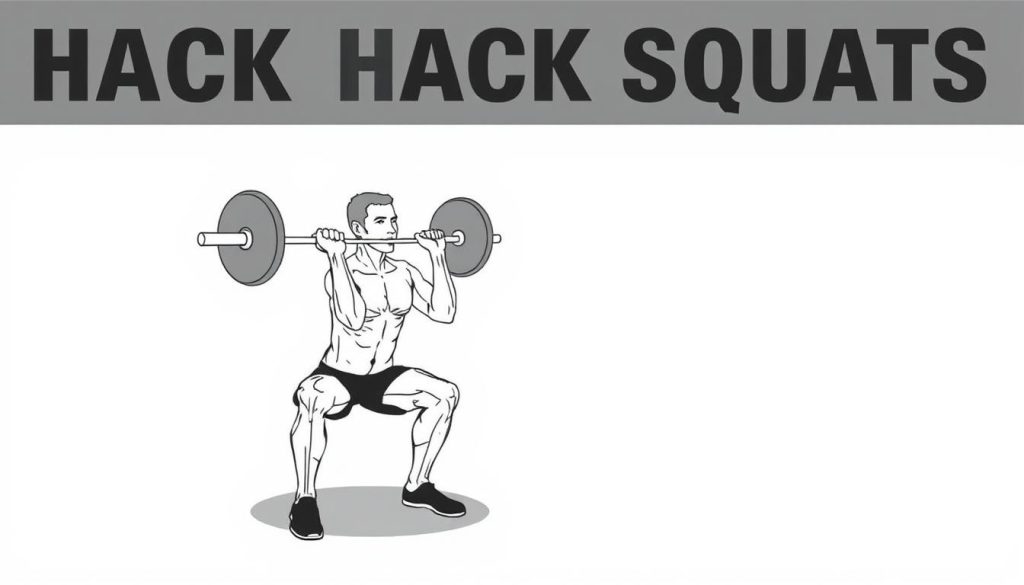
The barbell hack squat is a free-weight variation where you hold a barbell behind your legs and perform a squat motion. This exercise places significant emphasis on the glutes and hamstrings while requiring more stabilization than the machine version. To perform a barbell hack squat, stand with your feet shoulder-width apart, hold the barbell with your hands shoulder-width apart behind your legs, and squat down, keeping your back straight and your core engaged.
Landmine Hack Squat
Landmine hack squats utilize a barbell secured in a landmine attachment, allowing you to perform a squat pattern with angled resistance. This provides a unique stimulus to the glutes and quads while reducing spinal compression. To perform a landmine hack squat, secure one end of the barbell in the landmine attachment and hold the other end with both hands, then squat down, maintaining proper form.
Smith Machine Hack Squat
The Smith machine hack squat offers a middle ground between free weights and the hack squat machine, providing some guidance for the movement path while still allowing you to adjust foot position for optimal glute targeting. This variation can be particularly useful for those who are new to hack squats or need additional stability.
Each of these alternatives has its own unique advantages and can be incorporated into your training program either as a replacement for traditional hack squats or as complementary exercises to target the glutes from different angles and resistance profiles.
Conclusion
As we’ve explored throughout this guide, the hack squat is an effective exercise for targeting glutes and other key lower body muscles. By implementing the proper form, foot positioning, and programming strategies outlined here, you can maximize glute activation and see significant improvements in both strength and aesthetics.
The hack squat stands out as one of the most effective exercises for developing strong, well-defined glutes while building overall lower body strength. Consistency is key; incorporating hack squats into your workout routine regularly will yield the best results, especially when combined with proper nutrition and adequate recovery.
Don’t be afraid to experiment with different foot positions, rep ranges, and tempos to find what works best for your unique body structure and goals. Whether you’re using the hack squat as your primary glute builder or as part of a comprehensive lower body program, this versatile exercise deserves a place in your training arsenal for its unmatched ability to build impressive glutes and overall lower body development.